maintenance with a support desk

Your software runs. Who keeps it running?

I keep your app up to date and reachable, and your users report inside the app instead of to you. One fixed monthly fee, and every month a single page telling you what was reported, fixed and updated.

Cancellable monthly. No surcharge per report, no timesheet afterwards.
~/your-app · support hub
$ hub report --new
✓ report in: "the quote attachment does nothing"
✓ context attached: page, user, version
✓ sorted, draft ready, I review and send
// you hear about it once it is solved
$
€ 275 per month for Basic, cancellable monthly
1 page per month: reported, solved, updated
100% code, data and documentation are yours
sound familiar

It goes well, until it does not

You had software built and it does what it should. Then it goes quiet, and you are the one filling the gap.

The builder is busy or gone

Nobody really knows the app any more. Small things linger because you have to find someone every time, and that someone has to read themselves in first.

You are the help desk

Your users email and message you when something breaks. You ask what exactly they did, forward it on, and keep track in your head of what is still open.

Nobody keeps up with it

Updates, backups and certificates happen when someone remembers. Usually that works out. You find out on the day it does not.

what you get

Three layers, one monthly fee

Not a bundle of hours you have to use up. You buy that your software keeps running, that your users have somewhere to go, and that someone thinks along about what could be better.

01

Running

I host your app or manage the hosting you have, keep framework and packages current, install security patches, make backups that I actually restore to test them, and watch whether everything is still up. If something breaks, I respond within the agreed time.
02

Support desk

Your users get a button in your app: a question, a problem or an idea. Every report reaches me with the context already attached. I handle it and answer in the language of the person who reported it. You are no longer in the middle.
03

Better

We periodically walk through what was reported and what could be better. Small changes are part of your plan, anything larger gets a fixed price up front. That way your app keeps growing instead of standing still.
the support hub

The support desk is a product of its own

I had the problem myself: questions arrived by email, chat and passing remarks, and there was no single place where it came together. So I built the Support Hub. It is included with every plan.

hub.oggel-codelabs.nl
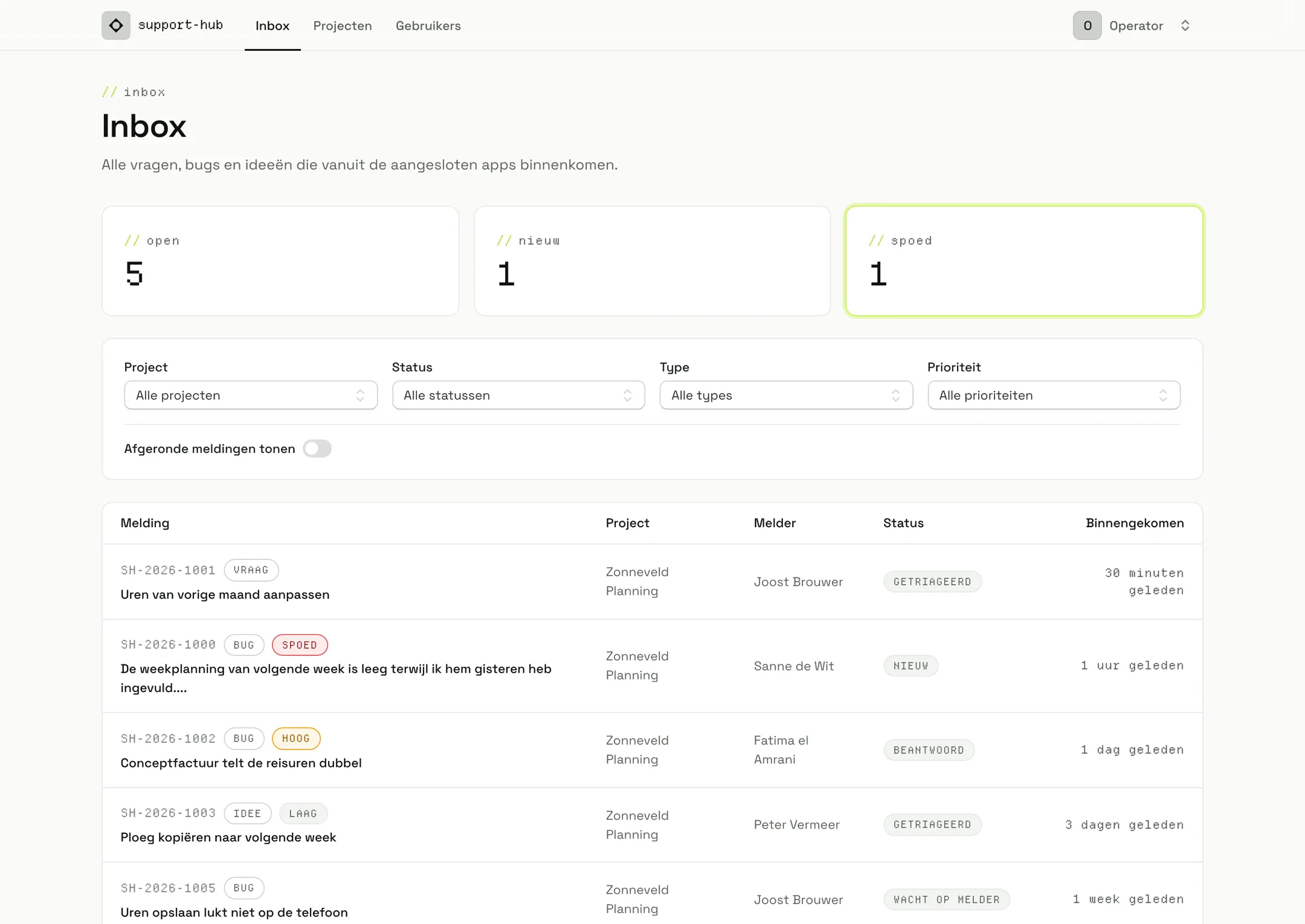
The Support Hub inbox with reports from a connected app
The inbox: everything that is open, from all your apps, in one place
in your app

Report it where it breaks

A small button sits in the bottom corner of your app. Your user picks question, problem or idea, types one piece of text and can attach a screenshot. Done in twenty seconds, without touching your inbox.

to me

Arrives complete and pre-sorted

The report reaches me with the context attached: which page, which user, which version. The hub sorts it and prepares a draft answer or a written-up bug report alongside it.

back

An answer from a person

I review the draft, change what needs changing, and send it. The reporter gets an answer by email in their own language, and can see the current status in that same email.

every month

One page for you

At the end of the month you get the overview: what was reported, what was solved, what was updated in your environment. You can also log in and follow along yourself.

The AI here is a tool, not a replacement. It sorts and drafts, I review and send. Nothing leaves without me having looked at it.
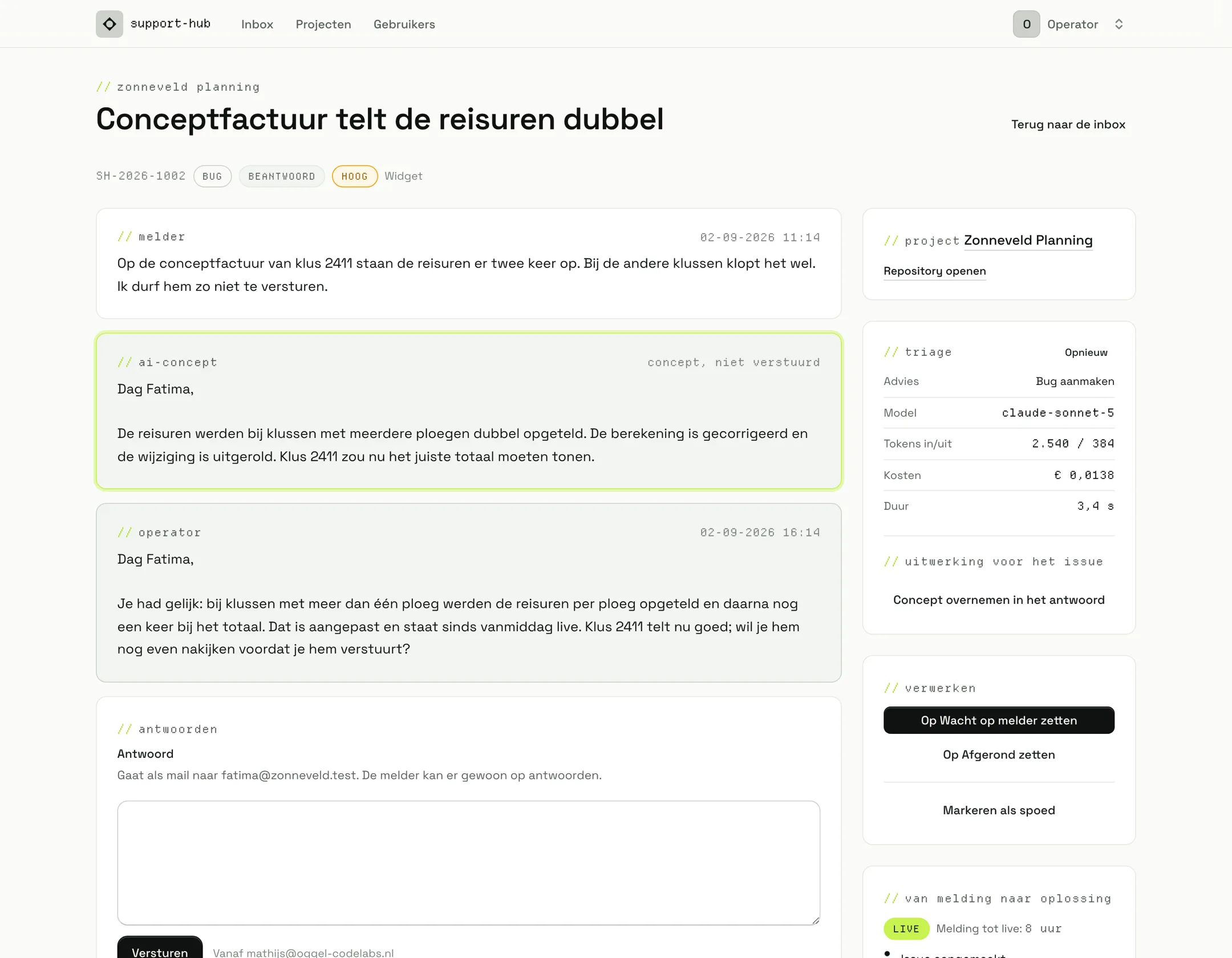
A report in the Support Hub with the triage draft and the sent answer
One report: the triage draft, my answer below it, and the route to live beside it
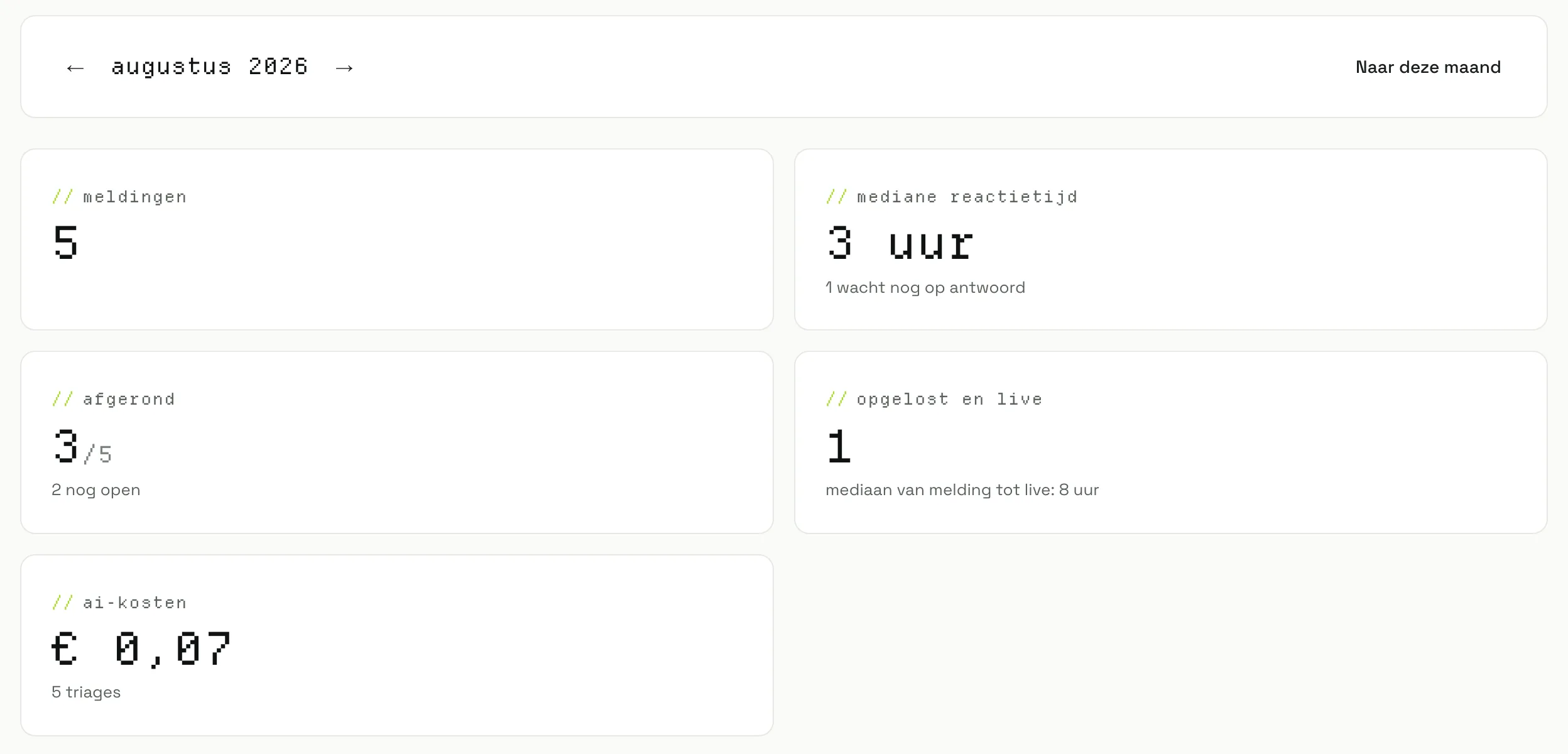
The monthly report for a project in the Support Hub
The monthly report you get each month, a single page

Screenshots from the hub with invented demo data. Never a customer's data.

continuity

And if you get hit by a bus?

I get that question more often than you would think, and I think it is fair. So this is part of every plan, whichever one you pick.

The code sits with you

In your own company's GitHub organisation, with me as a contributor. Not in mine, not on a laptop.

The access is yours

Hosting, DNS, mail, payments and API keys in a vault you own and I am a member of. Never again a password only I have.

There is a handover file

In every repository, and checked at every review session: how to deploy, where things run, who owns which account, how to restore a backup.

The hub is the memory

Every report, every answer and every monthly report sits in one place and can be exported. Whoever takes over knows what was going on, without having to call me.

Handover is prepared

If I am out for longer, a fellow developer takes over based on that file and that hub. We agree together at the start who that is, so it is someone who fits your environment.

You are not locked in

Cancellable monthly, no minimum term. If you stop, everything keeps running and nothing leaves with me.

plans

What it costs

One amount per month, excluding VAT, and you can simply read it here. Connecting your app to the Support Hub is included, setup as well.

entry

Basic

€ 275 per month, excluding VAT

  • Hosting and server management, where I host
  • Updates, security, backups and monitoring
  • Support desk in your app, within fair use
  • Response within 1 working day for an outage
Your app runs, you have a handful of users and an occasional wish.
Book an intro call
most chosen

Plus

€ 595 per month, excluding VAT

  • Everything in Basic
  • Support desk with wider fair use
  • Response within 4 working hours for an outage
  • Small changes are part of your plan
  • Quarterly review session, three people can follow along in the hub
You have real users and there is something every month.
Book an intro call
the software is the revenue

Premium

€ 1,150 per month, excluding VAT

  • Everything in Plus
  • Support desk unlimited within fair use
  • Response within 4 working hours, solved the same working day
  • Small changes with priority
  • A named contact, priority in planning, monthly review session
If your app stops, your business stops.
Book an intro call

The ground rules, up front and not in the small print

  • No surcharge per report. If you are structurally over fair use, that is a conversation about your plan and never a surprise on the invoice.
  • A report is at most an hour of work. Anything larger is a job: I tell you before I start and agree a fixed price with you first.
  • Having just a server managed, without the support desk, is also possible. That is € 105 per month.
  • Paying a year up front is possible: then you pay eleven months for twelve.
not built by me

Also for software someone else built

Do you have an app I did not build? Then I will not take it on blind. We start with a technical review or a shorter maintenance inspection, so that we both know what is there. You get an honest picture of what is solid and what is not, and only then a maintenance proposal.

For software I built myself that is not needed. I already know the state it is in.

Frequently asked questions

What counts as a report?

Anything a user gets stuck on or wonders about: an error, a question about how something works, a text that is wrong, an idea for something that could be easier. The rule of thumb is that a report is at most an hour of work. Anything larger is a job, and I tell you before I start.

And if something bigger needs doing?

Then you hear up front what it is and what it costs. Small changes are part of your plan on Plus and Premium. Anything beyond that is a job and gets a fixed price, and for something substantial a short quote. You never run into an amount afterwards that you did not agree to.

What happens when you are on holiday or out of action?

For a holiday I agree in advance who is reachable and what does and does not continue. If I am out for longer, there is the handover file and the hub, and we agree at the start which fellow developer takes over in that case. That is exactly why those five continuity agreements are part of every plan.

Who owns the code and the data?

You do. The code sits in your own company's GitHub organisation, the access in a vault you own, and the reports and monthly reports in the hub can be exported. I have access because I do the work, not because I own it.

Where is my data stored?

In Europe. For maintenance we sign a data processing agreement, because I come into contact with your users' data. The hub stores only what is needed per report to solve it, and reports are cleaned up after a while.

Can I cancel?

Monthly, without giving a reason and without a minimum term. Your software keeps running, the code is already with you, and the handover file is there. That is not a parting gift, it is something that exists from day one.

a conversation, not a quoting process

Shall we look at what your software needs?

In 30 minutes we know whether this fits. If it does not, I will say so, and I usually know what would help you instead.